

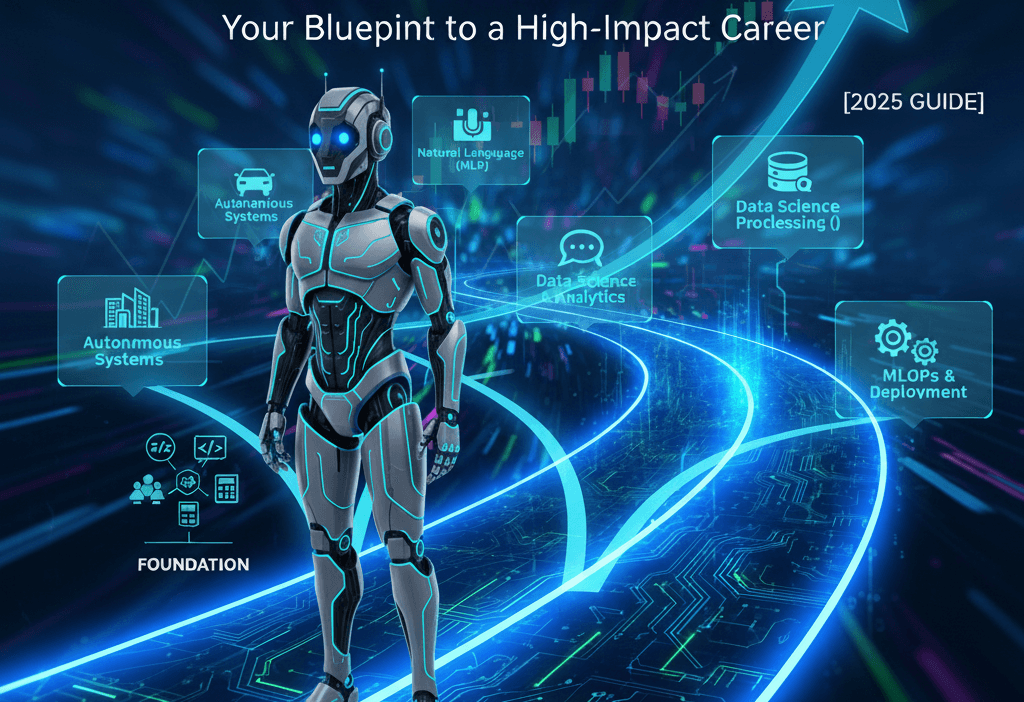
The future is intelligent, and at its helm is the AI Engineer. Far more than just data scientists or software developers, AI Engineers are the architects who build, deploy, and maintain the intelligent systems that power everything from self-driving cars to personalized recommendations. If you’re passionate about shaping the next generation of technology and want a career that’s both challenging and incredibly rewarding, understanding the AI Engineer roadmap is your first critical step.
This comprehensive guide will break down the essential skills, tools, and experiences you need to navigate this dynamic field, providing a clear blueprint for your success.
Phase 1: Building Your Core Foundation (The Bedrock Skills)
Before you can build intelligent systems, you need a rock-solid technical base. Think of these as your indispensable tools.
1. Programming Prowess (Python is King!):
- Why Python? Its simplicity, vast libraries (NumPy, Pandas, Scikit-learn), and community support make it the undisputed champion for AI/ML.
- Beyond Basics: Master Data Structures and Algorithms (DSA). This isn’t just for interviews; it’s about writing efficient, scalable code.
- Action: Practice coding challenges, build small projects.
2. Mathematical Muscl (Don’t Skip This!):
- Linear Algebra: Essential for understanding how data is represented and manipulated in models (vectors, matrices).
- Calculus: Critical for comprehending optimization algorithms (like gradient descent) that train neural networks.
- Probability & Statistics: Fundamental for data analysis, model evaluation, and understanding uncertainty.
- Action: Review university-level courses, use resources like Khan Academy, and apply concepts to data problems.
3. Data Handling & Database Skills:
- SQL Mastery: The lingua franca for querying relational databases. You’ll constantly interact with data.
- Data Manipulation: Proficiency with Python’s Pandas for cleaning, transforming, and preparing data for models.
- Big Data Concepts (Bonus): Familiarity with tools like Apache Spark or Hadoop is a huge advantage for large-scale data.
- Action: Practice SQL queries, work with messy datasets, learn data preprocessing techniques.
Phase 2: Diving Deep into Machine Learning & Deep Learning (The Intelligence Core)
This is where you learn to make machines “think.”
1. Machine Learning Fundamentals:
- Concepts: Understand Supervised, Unsupervised, and Reinforcement Learning.
- Algorithms: Get comfortable with classic algorithms: Linear/Logistic Regression, Decision Trees, SVMs, K-Means, etc.
- Model Evaluation: Learn metrics like accuracy, precision, recall, F1-score, and AUC-ROC.
- Action: Complete online courses (Coursera, edX), implement algorithms from scratch.
2. Deep Learning & Frameworks:
- Neural Networks: Grasp the architecture and working principles of ANNs, CNNs, RNNs, and Transformers.
- Frameworks: Become proficient in at least one, ideally two, industry-standard frameworks:
- TensorFlow: Robust, production-ready, backed by Google.
- PyTorch: More flexible, Pythonic, popular in research.
- Action: Build and train deep learning models for image classification, sequence prediction, etc.
3. Specialized AI Domains (Choose Your Focus):
- Natural Language Processing (NLP): Work with text data, build chatbots, sentiment analysis, and understand the magic of Large Language Models (LLMs) and Generative AI.
- Computer Vision (CV): Process image and video data for tasks like object detection, facial recognition, and image generation.
- Action: Pick an area that excites you and delve deeper with specialized courses and projects.
Phase 3: Productionizing AI (MLOps & Deployment)
This is what truly differentiates an AI Engineer from a pure researcher or data scientist – the ability to deploy and manage AI in the real world.
1. Cloud Computing Expertise:
- Platforms: Gain hands-on experience with at least one major cloud provider: AWS, Google Cloud Platform (GCP), or Microsoft Azure.
- AI/ML Services: Learn their specialized ML services (e.g., AWS SageMaker, GCP AI Platform, Azure Machine Learning).
- Action: Deploy a simple ML model to the cloud, understand cloud infrastructure basics.
2. MLOps Tools & Practices:
- Containerization (Docker): Package your applications and models into isolated containers for consistent deployment.
- Orchestration (Kubernetes): Manage and scale containerized applications.
- MLOps Platforms: Explore tools like MLflow, Kubeflow, or Weights & Biases for experiment tracking, model versioning, and lifecycle management.
- Action: Containerize one of your projects, explore an MLOps platform.
3. Software Engineering Best Practices:
- Version Control (Git): Non-negotiable for collaboration and tracking code changes.
- Clean Code & Testing: Write maintainable, testable code.
- API Development: Expose your models as APIs for other applications to consume.
- System Design: Understand how to design scalable, fault-tolerant AI systems.
- Action: Use Git for all projects, write unit tests, try building a simple Flask/FastAPI endpoint for a model.
Phase 4: Gaining Real-World Experience (Your Differentiating Factor)
Theory is great, but application makes you employable.
1. Build a Powerful Portfolio of Projects:
- Go Beyond Tutorials: Tackle real-world problems. Find datasets on Kaggle or build end-to-end projects from data collection to deployment.
- Showcase Diversity: Include projects demonstrating data handling, model training, and model deployment/MLOps.
- Action: Dedicate consistent time to project building, document your work on GitHub.
2. Internships & Entry-Level Roles:
- Seek out internships as a “Machine Learning Engineer Intern” or “Applied Scientist.”
- Early career roles like “Junior AI Engineer” or “MLOps Engineer” are stepping stones.
- Action: Network, tailor your resume, practice behavioral and technical interviews.
3. Continuous Learning & Networking:
- Stay Updated: The AI landscape evolves rapidly. Read research papers, follow AI thought leaders, and experiment with new tools (e.g., the latest generative AI models).
- Community: Attend meetups, conferences, and engage in online forums. Networking can open doors.
- Action: Allocate dedicated time each week for learning and community engagement.
Your Future as an AI Engineer: A High-Impact Career
The path to becoming an AI Engineer is rigorous, demanding a blend of theoretical knowledge and hands-on engineering prowess. However, the rewards—both in terms of innovation and compensation—are substantial. You’ll be at the forefront of technological advancement, building the intelligent systems that will define our future.
Start today, be persistent, and embrace the continuous learning journey. Your blueprint to a high-impact AI career is now in your hands. Go build!


Absolutely with you it agree. It seems to me it is very excellent idea. Completely with you I will agree.
It is simply excellent phrase
What remarkable phrase